
playing favorites
a closer look at 3 of my favorite sentences from KILL CREATURES

hello from a late november afternoon! it is dark as hell outside and look, i am not a summer person—i would prefer that it be under 60 degrees fahrehneit at all times—but holy mother of god i miss the sun.
two upcoming events to keep an eye out for before i get to our main topic!
i’ll be at Once Upon a Bookstore in Fall River, MA on November 19th for a horror panel!
i’ll be at St. Louis Teen Book Fest on December 6th!
RIGHT okay. i mentioned in my last newsletter that i’ve been wanting to talk a little more about craft, so for today’s installment i thought i’d break down three of my favorite lines from KILL CREATURES—really get into what i like about them, how they’re built, and what i was hoping to get across by building them that way.
disclaimers!!!!
i can speak only to my intent in writing these sentences—whether or not that intent is fully and successfully realized in each line is not for me to say! you might go through these like “????? that’s not how these read at ALL” and that would be fair enough
furthermore the degree to which my intent as the author might matter to you, the reader, is entirely variable, and any particularly barthesian newsletter subscribers would be forgiven if they decided to close out of this post immediately lmao
in a lot of places when i am making what would otherwise be grand sweeping statements about narrative i will usually qualify them with “i think,” by which i mean not that I, RORY POWER, am the FIRST to EVER CONSIDER THIS CONCEPT!!!!! but more that this is simply one of many possible arguments/opinions and to discuss narrative is to embrace an inherent subjectivity
this newsletter is spoiler free!
SENTENCE 1
i am a beginnings obsessive. without the exact right opening line(s), i can’t make any progress on a book, even if i know all sorts of details about the plot and characters. there is just something about the way the right opening feels—like the clunk of the shifter going from park to drive.1 it’s a physical settling, with real weight and heft, and i always know it when i feel it.
i tried a few for KILL CREATURES, but none of them gave me that feeling until this one:
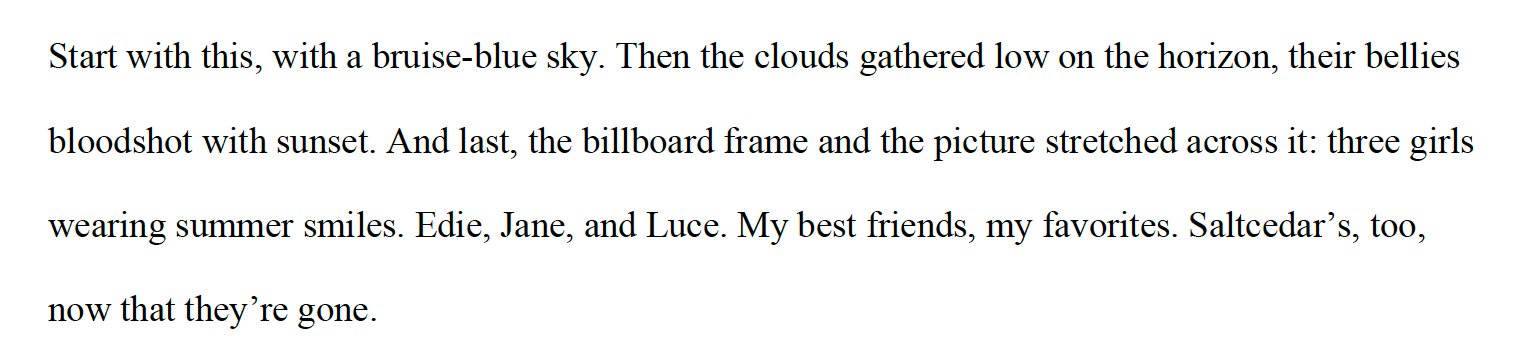
i absolutely love that the book begins with an imperative. yes, part of it is just silly satisfaction with the literalness of the first word being “start,” but beyond that i think it’s an effective way to communicate a lot about the narrative and the narrator, even if that communication only happens on a subconscious level for a reader.
the imperative serves as an immediate reminder of the constructed nature of the story (by “story” i mean here both the book itself and, within it, nan’s version of events). it also underlines the gap in power between the narrative and the reader. the latter cannot influence the former; it can’t obtain knowledge of the narrative that the narrative doesn’t wish for it to have.
i think that power gap is almost always there2 in a work of fiction, and as writers we can choose to play up or deemphasize it—maybe we keep the POV really close and limited so that the reader can feel a degree of ownership over the main character’s actions, for example. that’s something i’ve tried to do with my other YA books, but with KILL CREATURES, i wanted to try to build more dissonance between the reader and the narrative, so right out of the gate, the text is saying, “we are not equals. start with this.”
that tells us about the overall narrative, but it also teaches the reader about the book’s specific narrator. this is our first glimpse at how nan experiences the world, and from it we can see that she is concerned more with what you, the reader, see of her life than with the totality or truth of it. (that said, while the implied addressee of the command to “start” is the reader, you could also read it as nan addressing herself, commanding herself to focus on a particular slice of reality and ignore anything else.)
a companion to this opening graph comes later in the book, as part of the “then” timeline.

this isn’t an exact mirror of the book’s opener—it’s the first paragraph of the second “then” chapter, not the first graph of the whole “then” timeline, and the imperative verb (“find”) is one less obviously related to how the narrative is presented—but i felt like sneaking the imperative in under the radar, so to speak, made sense with how nan thinks about her past. memory and truth are much the same thing to her, so this hint toward unreliability/subjectivity only pokes through the “then” timeline after she’s already begun it.
SENTENCE 2
before we get into the nuts and bolts with this one, a detour to talk about meter and scansion! yay!3
my first exposure to meter/scansion came in my english lit classes, but i also took a lot of latin classes from middle school into high school. the thing with latin is that you run out of road pretty quickly in terms of learning to actually speak it,4 so by the back half of high school our classes were mostly spent translating the aeneid. the aeneid is an epic poem in dactylic hexameter; we scanned5 each line as we translated, and i think that extra emphasis on meter is to blame for the way it shows up in my own prose.
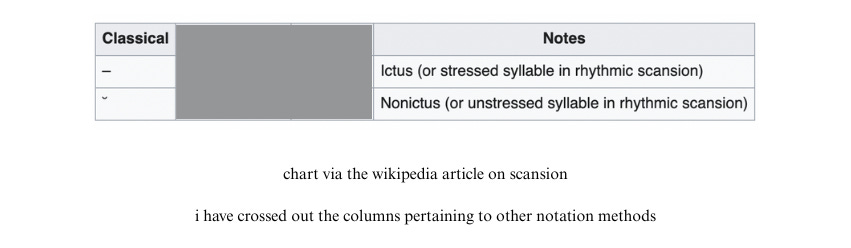
to scan my chosen KILL CREATURES sentence i’ll use classical notation. wikipedia describes classical notation as “generally out of favor”6 (???? like okay just call me OLD while you’re at it), so here’s a reference chart if you’re not familiar/need a refresher/prefer more hip modern scansion notation.
and an example of what it looks like in practice:
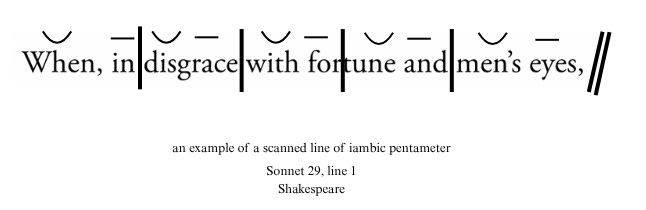
the vertical lines here are separating metric feet, while the double line marks a line break. and of course, one’s interpretation of meter is subjective! the sonnet 29 example i gave scans the line if it were to adhere exactly to the metric requirements of iambic pentameter, but you could also scan it in a way that more closely reflects the line’s vernacular rhythm—stress on “when,” maybe, with no stress on “in” and stress on “men’s.”
so now that we’ve done all that!!!! here is the paragraph i like.
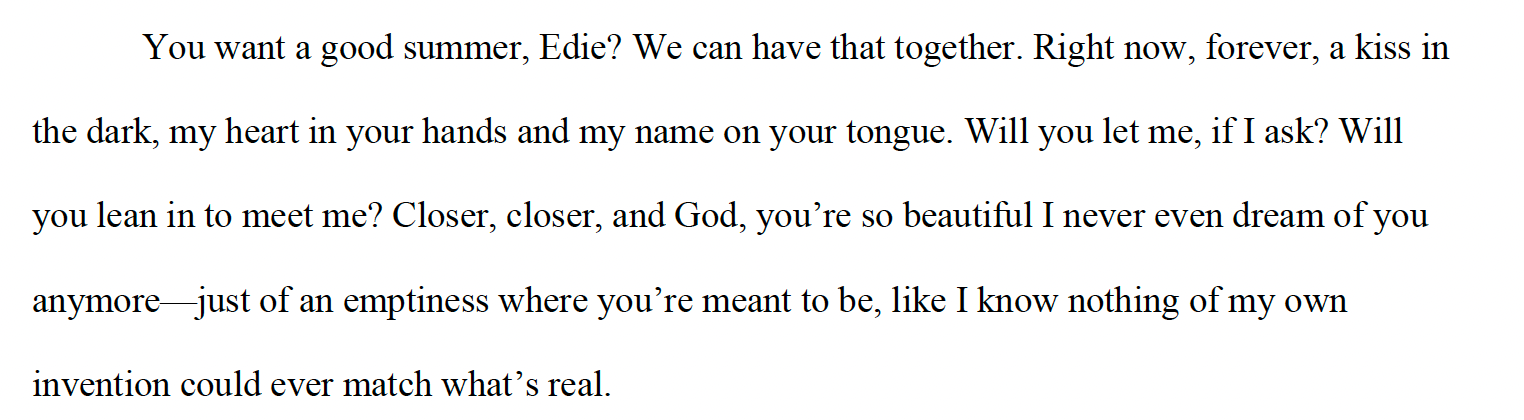
more specifically, i mean the line that begins with “Right now,” which to me scans as a couplet in dactylic tetrameter, like so:

there are two feet here that technically aren’t dactyls—“dark, my” and “tongue” don’t have enough syllables—but to my ear they don’t break the overall effect of the meter. the missing syllable in “dark, my” works as a breath between lines, setting up a cadence leading to “tongue” that matches the first line of the couplet.
a reasonable question to now ask is “…. so what?"
the rest of the paragraph doesn’t scan in any consistent meter. when we do fall into dactylic, i think the rhythm pulls us out of the everyday and the real (nan wants edie) and into fantasy, possibility (nan and edie get together). the dactylic tetrameter lines take on an almost incantatory feeling. this is nan wishing for something; she’s describing what she wants as though she were casting a spell.
of course, the spell doesn’t last. the sentence that follows (“Will you let me, if I ask?”) sounds to me like all stressed syllables—a complete break with dactylic, and a rude reminder that nan has no power here. she can ask, but edie is actually in control.7
SENTENCE 3
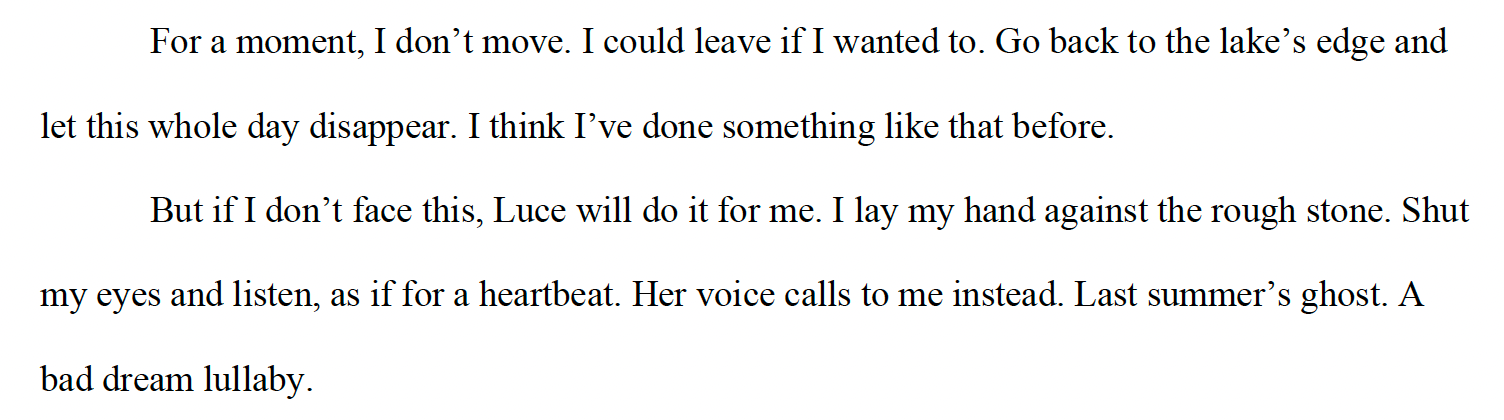
there are a few things i like about this section. i like the image of listening for a heartbeat in the canyon wall, and i like that the bit about hearing luce’s voice can be tied back to other places where the same kind of language pops up.8 but the phrase that makes this snippet one of my favorites is “bad dream lullaby.”
first of all, it sounds rad.
second of all, i think there’s a lot of meaning living in the way those three words are arranged, which i have elaborated on here in bullet form:
the swapped order of “dream” and “lullaby”
lullabies generally precede dreams—we sing them to people as they fall asleep—but here their order is literally reversed, which is a fun indication of the loose relationship nan has with reality.
the connotationally incorrect, so to speak, combo of a “lullaby” and a “bad dream”
generally we associate lullabies with Nice Things™—comfort, reassurance, the expression of care and love, wishing someone “sweet dreams,” etc. putting “lullaby” next to “bad dream” feels off. but by keeping “dream” in the mix (as opposed to using “nightmare” or something) you get this feeling of it ALMOST fitting, which is really appropriate for nan.
my hope is that a phrase like this, small as it is, can help create an overall atmosphere for the book and reinforce our sense of nan down to the text’s atomic level.
that’s it for this post! i hope it was interesting and/or entertaining. and if it wasn’t, count yourself lucky, because i was originally gonna do 5 sentences but then substack was like “heyyyyy sooooo this is getting to be a Lot”
i will likely be back in your inbox one more time before the year is out with a wrap up, some yearly favorites, etc. in the meantime, i hope you and your loved ones are safe and well.
sending you the very best wishes,
rory
note i do NOT mean the feel of the engine vibrating or the change in the engine sound!m i specifically mean the like ca-chunk feel of the shifter finding the new gear! you know the feeling it’s the best
a number of people would disagree with me including a man called stanley fish (which is an incredible name) and other proponents of reader-response theory
not sarcastic!!! i love this shit!
(although if anyone wants to discuss grumio and cerberus hit me up) (in latin) (obviously)
as in, “the act of using scansion,” not “the act of running a sheet of paper through the scanner on my printer”
although wiki DOES have that assertion marked “citation needed” so maybe we can just attribute it to one wiki editor with a grudge
if we’re really getting into it, “have that together” right before the dactylic line is ALSO dactylic and could be read as nan’s mind starting to shift gears as she imagines the future she wants
i’m thinking in particular of one spot where nan says she used to hear her own name in her father’s voice, but now his voice has been replaced by luce’s
Currently enjoying “Wilder Girls”. Kudos Rory on a gripping page turner!